Why Aerospace Sealing is So Demanding
In aerospace engineering, sealing isn’t just about preventing leakage; it’s about safeguarding the reliability and performance of systems that operate in some of the world’s harshest environments. Whether on a commercial jet, military aircraft, spacecraft, or satellite, seals must function far beyond the limits of most industrial applications. Temperatures can swing hundreds of degrees in minutes. Pressures fluctuate dramatically. Fluids are highly engineered and often corrosive. And the margin for error is almost nonexistent.
In This Blog:
- Extreme Operating Environments
- Thermal Extremes and Rapid Cycling
- Pressure and Vacuum Fluctuations
- High Speed and Vibration
- Where Ergoseal Excels
- Material Demands in Aerospace Applications
- Chemical Compatibility is Non-Negotiable
- PTFE as a Critical Aerospace Material
- Balancing Weight and Durability
- The Precision Aerospace Seals Require
- Dimensional Accuracy and Tolerance Stack-Ups
- Uncompromising Quality and Traceability
- Complex Engineering Requirements
- Extensive Testing and Validation Standards
- Aerospace Sealing Demands More than a Standard Solution
These factors make aerospace sealing one of the most demanding specialties in engineering. They’re also why selecting the right sealing partner is vital. You need one with the expertise, validation processes, and manufacturing precision required to produce seals that perform under extreme conditions.
Extreme Operating Environments
Thermal Extremes and Rapid Cycling
Temperatures can range from below –50°F at altitude to several hundred degrees near engines and exhaust systems. These shifts occur quickly during takeoff, ascent, cruise, and landing, forcing materials to expand and contract repeatedly. Seal materials must retain dimensional stability, low friction, and resistance to compression set under constant thermal cycling.
Pressure and Vacuum Fluctuations
Seals in hydraulic systems, fuel systems, ECS units, and turbomachinery endure wide pressure ranges, including:
- high differential pressures
- fluctuating vacuum conditions
- altitude-driven pressure changes
High Speed and Vibration
Rotodynamic components such as compressors, pumps, and actuators subject seals to high rotational speeds, harmonic vibration, and both axial and radial movement. Hardware may distort under heat, and in these conditions, even slight deviations in surface finish or concentricity can increase friction or degrade sealing integrity.
As Ergoseal Global PTFE Product Manager Gerald Strenk explains, engineers must consider:
- thermal expansion and differential growth
- tolerances
- surface finish
- groove design
- lip geometry and contact pressure
- material selection
- lubrication and break-in periods
Where Ergoseal Excels
Ergoseal’s tight-tolerance machining, precision grinding, and application-driven engineering enable seals to perform reliably across this spectrum of thermal, pressure, and motion-related challenges.
Material Demands in Aerospace Applications
Seals must withstand aggressive fluids and chemical environments characteristic of aerospace systems. Many of these fluids become increasingly reactive as temperatures rise, making material compatibility essential to preventing swelling, softening, or chemical breakdown.
Chemical Compatibility Is Non-Negotiable
Common aerospace fluids include:
- Jet-A fuel
- hydraulic fluids such as phosphate esters (e.g., Skydrol®)
- synthetic lubricants
- heat-transfer fluids and coolants
- Deicers
- specialized oils
Each interacts differently with seal materials, making chemical compatibility a critical factor in long-term performance.
PTFE as a Critical Aerospace Material
PTFE and filled PTFE blends are widely used in aerospace sealing for their high-temperature capability, low friction, and minimal chemical reactivity. They perform reliably in dynamic environments where seals must handle wide temperature ranges and variable loads.
Ergoseal’s expertise with PTFE and custom filler systems (including graphite, bronze, and carbon) enables tailored solutions for specific aerospace applications.
Balancing Weight and Durability
Weight is always a consideration in aircraft design. Seals must provide robust performance without adding unnecessary mass, driving the use of lightweight, high-strength materials.
The Precision Aerospace Seals Require
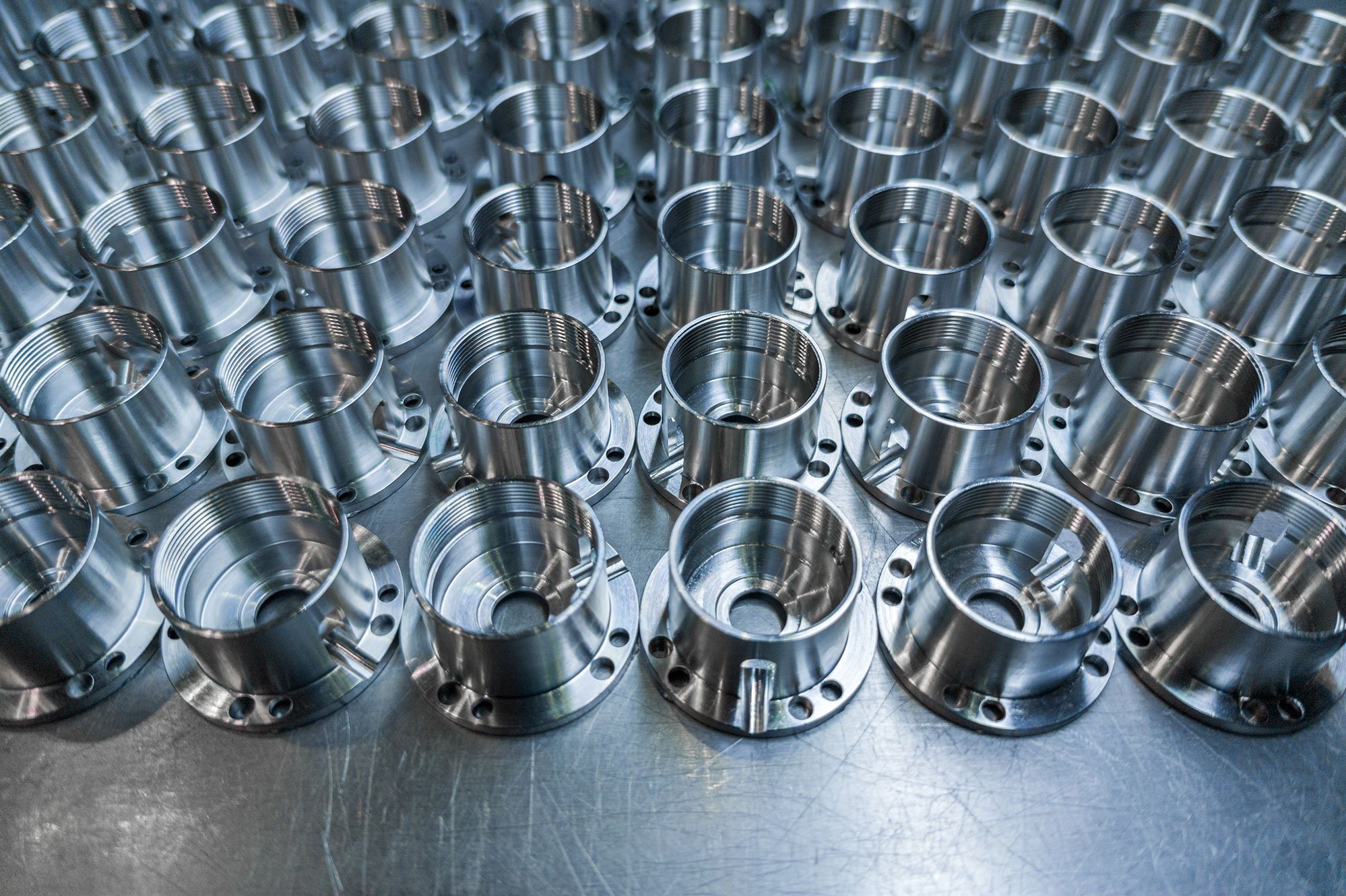
Aerospace sealing requires precision measured in microns. The smallest variation in dimension or surface texture can influence sealing performance — especially under high pressure, vibration, or rapid cycling.
Even minor changes in surface roughness affect leakage, friction, wear, and overall seal life. A sealing surface that isn’t properly matched to its mating hardware can degrade rapidly. In aerospace environments, surface finish becomes a functional element of the design, not simply a specification.
Ergoseal’s machining, grinding, and metrology capabilities allow the team to achieve ultra-consistent finishes and geometric accuracy, ensuring seals interface predictably with surrounding components.
Dimensional Accuracy and Tolerance Stack-Ups
Aerospace assemblies undergo strict inspection to minimize tolerance stack-up and maintain reliable sealing interfaces. Ergoseal engineers account for these effects during design and verify dimensional accuracy throughout production.
Uncompromising Quality and Traceability
Aerospace manufacturers expect consistent, documented quality at every stage. AS9100D — the industry’s leading quality standard — establishes these requirements. Ergoseal is one of only four seal suppliers in the United States certified to this standard and the only privately held company among them.
Traceability is equally critical. Aerospace OEMs require complete transparency: material certifications, machining records, inspection data, and test results. This documentation supports field reliability, maintenance programs, and compliance across the supply chain.
Ergoseal’s systems deliver this level of accountability, ensuring confidence in every seal produced.
Complex Engineering Requirements
Strong quality systems set the foundation, but sealing performance depends on understanding how a seal behaves within the larger aerospace system. A seal’s performance can be influenced by:
- hardware expansion and contraction
- dynamic motion
- pressure and temperature cycles
- chemical exposure
- assembly tolerances
- lubrication behavior
- long-term durability
Because these variables shift during every mission cycle, aerospace sealing often requires tailored, application-specific designs. Ergoseal collaborates early with customers to evaluate materials, refine geometries, model performance, minimize friction and wear, and build reliability into the system.
Extensive Testing and Validation Standards
Before any aerospace seal is approved for use, it must undergo rigorous testing, such as:
- thermal cycling
- pressure and vacuum testing
- leakage measurement
- vibration and endurance simulation
- detailed dimensional inspection
Ergoseal’s FSAV (Feasibility Study and Advanced Verification) process adds value early in development. Through FSAV, the team performs feasibility assessments, performance modeling, durability and leakage verification, and design recommendations before full production. This reduces risk, shortens development cycles, and increases confidence for programs with strict reliability requirements.
“From an engineering perspective, especially for aerospace customers, the biggest advantage of FSAV testing and validation is risk mitigation and reliability assurance,” Strenk explains. “Aerospace systems operate in extreme environments where failure can be catastrophic. FSAV ensures that every component and system meets stringent safety and reliability standards.”
Aerospace Sealing Demands More than a Standard Solution
Aerospace systems push materials and engineering to their limits. Extreme temperatures, reactive fluids, tight tolerances, and stringent quality requirements make sealing a critical factor in overall system performance.
Meeting these demands requires more than a standard solution — it calls for expertise, precision manufacturing, robust validation, and complete traceability.
Ergoseal brings these strengths together. From advanced PTFE capabilities and custom seal design to AS9100D-certified quality and the FSAV process, the team is equipped to solve complex sealing challenges and support reliable operation in the harshest aerospace environments.
If you’re developing or refining an aerospace application, our team is ready to collaborate early, solve complex challenges, and help you move forward with confidence. Contact us to start the conversation.